
Kenya’s nutrition scorecard tool was launched nationally in 2020. It was then decentralised to county and sub-county levels to help health teams identify and address gaps in nutrition programmes.
Kakamega County, in western Kenya, began its action and accountability journey in 2022, adopting the scorecard with seven prioritised indicators. The scorecard is a living diagnostic tool that catalyses data-driven decision-making.
The challenge
At Kamuchisu health centre in Malava Sub-County, children enrolled in the Supplementary Feeding Programme to tackle malnutrition received ready-to-use therapeutic foods and fortified blended flours, but many failed to exit within the recommended two-month window. Recovery rates stagnated, and dependency on the programme deepened. Frequent stockouts of therapeutic commodities left children without the supplies needed to recover.
In Nzoia Sub-County, a different but persistent challenge emerged. Most mothers left home for long periods to do casual farm labour, such as weeding, planting, and harvesting. With no refrigeration and no breast milk substitute, infants were left with family members who fed them solid foods. This undermined exclusive breastfeeding and put infants at nutritional risk.
The underlying issue in both communities was that most households were economically disadvantaged and food insecure. Cash crop farming dominated agricultural land, limiting subsistence food production. Gaps in nutrition knowledge, food diversity, and child feeding practices made the problem worse. As a result, both regions recorded high rates of malnutrition.
In 2023, shortly after the facility had opened its doors, 20% of the children we saw at the clinic presented with signs of malnutrition.
Wycliffe Juma, nursing officer in-charge, Nzoia Dispensary
How the county responded
In 2024, to address these challenges, county and sub-county teams designed responses rooted in community ownership, local knowledge, and use of local resources. Interventions included community-based management of acute malnutrition, rolling out the Baby Friendly Community Initiative, and integrating WASH (water, sanitation, and hygiene) programming.
Community-based management of acute malnutrition
Recognising that facility-based interventions alone were insufficient, the county trained community health promoters (CHPs) to identify, manage, and follow up on malnourished children at home.
The health promoters received nutrition screening kits to conduct household assessments and record findings in mother-child booklets. This approach closed gaps in care; if a child missed facility screening, a health promoter could identify them at home. At Kamuchisu, health promoters reached 67 children initially identified as malnourished with this approach.
Community dialogues helped identify the root causes of the issues. Health teams found most families depended on cash crop income and lacked dietary diversity. With the causes identified, health promoters:
- led cooking demonstrations
- trained mothers and caregivers on balanced feeding for all ages
- set up kitchen garden demonstration sites to promote subsistence food production.
Households received seedlings for leafy green vegetables, vitamin A-rich vines, and guidance on raising small animals like hens for eggs to improve food diversity.
The Baby Friendly Community Initiative and mother support groups
In Kamuchisu and Nzoia, the county nutrition team rolled out the Baby Friendly Community Initiative (BFCI). This initiative is a community-based Ministry of Health programme. It enables communities to adopt high-impact nutrition initiatives, including:
- optimal breastfeeding
- appropriate complementary feeding
- maternal nutrition
- environmental sanitation
- hygiene
During a scorecard review session, we concluded that if we rolled out this programme, we would be able to manage children at the community level using the locally available resources. That is the readily available foods rather than the supplementary dietary items that the county occasionally provides.
Margaret Oyugi, county nutrition coordinator, Kakamega County
With the support of community health promoters, pregnant women and mothers of children under two joined structured mother-to-mother support groups, an approach recommended by the Baby Friendly Community Initiative. These groups provide a consistent platform for nutrition education, peer learning, growth monitoring, and feeding support, ensuring every new mother is welcomed into a network of knowledge and accountability.
The mother-to-mother support groups continued to be helpful even after delivery. A community health promoter (CHP) was assigned to me to help initiate breastfeeding and to support me in exclusively breastfeeding my son for the first six months. The health promoter regularly monitored my progress through home visits. Currently, we have 12 mother-to-mother support groups and three teen mother support groups in my community health unit.
Vivian Moraa, community member and Baby Friendly Community Initiative beneficiary
Group members support each other through pregnancy, birth, and the crucial first two years of a child’s life, when nutrition matters most. At the health centre in Nzoia, implementation of the Baby Friendly Community Initiative led to the creation of a resource centre that serves as a knowledge hub for these groups, covering food groups, breastfeeding, maternal nutrition, and child feeding.
For the last two quarters, we have not reported any cases of underweight or malnourished children.
Wycliffe Juma, nursing officer in-charge, Nzoia Dispensary
Integrating WASH (water, sanitation and hygiene)
Malnutrition and waterborne disease form a mutually reinforcing challenge, with diarrhoea depleting a child’s nutritional status, while malnutrition weakens immune defences against infection. Nzoia’s community health unit addressed this by embedding a WASH (water, sanitation, and hygiene) component within its Baby Friendly Community Initiative programme.
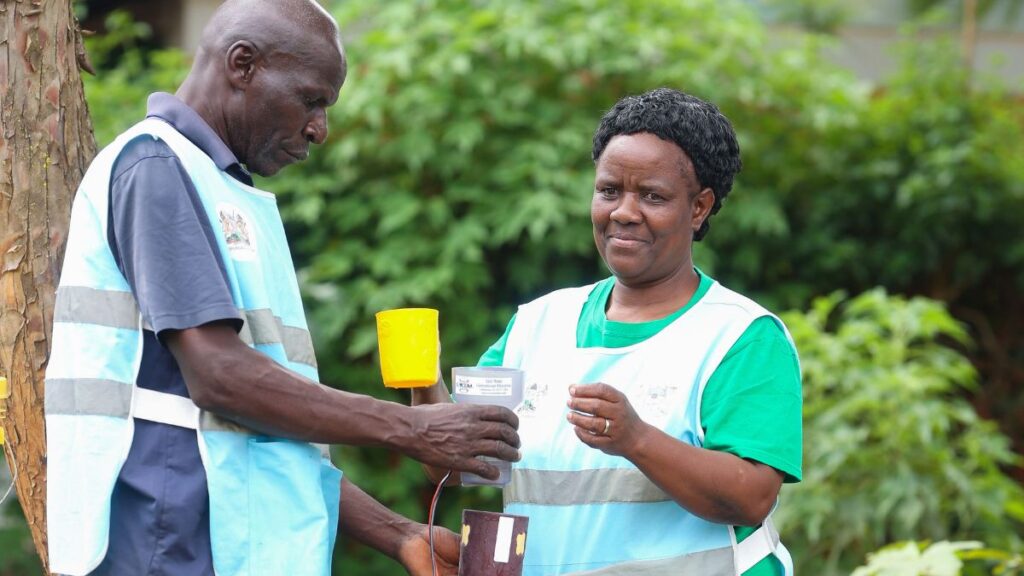
With support from Safe Water International Ministry, the community received chlorine-producing machines, giving households a reliable, low-cost water treatment solution. A partnership with Hope to Others also provided water filters as an additional option. These interventions have reduced diarrhoeal disease among children in the area, breaking the cycle that undermined nutrition recovery.
Sustainability and community ownership
In the Kamuchisu community health unit, health promoters recognised that malnutrition is also driven by economics. They encouraged mother-to-mother support groups to start income-generating activities.
One initiative is table-banking, where group members contribute to a collective fund that is distributed to each member on a rotating basis. With the community health promoters’ encouragement, members have used proceeds to buy dairy cows, giving households a steady source of milk and improving nutrition for families with young children.
Community health promoters are a critical pillar of community-based management of acute malnutrition, but their work is often limited by inadequate resources.
To address this, community health promoters in the Kamuchisu health unit expanded their efforts. They started a beekeeping project and collective dairy farming, enabling each member to own a cow. Income from honey sales provides a steady revenue stream that sustains their community engagement.
Proceeds have also funded kitchen garden demonstration sites, seedling procurement, and nutrition education materials, keeping health initiatives running on sustainable domestic resources.
Impact
- Acute malnutrition: Kamuchisu health centre previously reported a 40% active malnutrition rate in 2023. Now, it reports zero cases. Similarly, Nzoia Dispensary reduced its active malnutrition caseload from 20% in 2023 to zero.
- WASH (water, sanitation, and hygiene) outcomes: In the Nzoia Community Health Unit, the prevalence of diarrhoeal diseases has declined substantially. Reported diarrhoea cases fell from 217 in 2023 to just 27 in quarter 1, 2026, demonstrating the positive impact of improved access to safe drinking water.
- National recognition: Community health promoters and community health assistants from the Kamuchisu community health unit were invited to a national platform to share their vitamin A and Baby Friendly Community Initiative models. The facility has received multiple awards for its measurable progress, and lessons from Kakamega are now being shared county-wide.